Are you working as a babysitter or planning to start? This guide covers the updated 2026 rates in Spain, the average hourly pay, and practical examples to help you decide how much to charge based on your experience, location, and work schedule.
Are you working as a babysitter or thinking about starting out? Here you’ll find everything you need to know about what to charge in 2026. In Spain, the average hourly rate for a babysitter in 2026 is around €9.46 gross, according to data collected by Sitly based on thousands of babysitter profiles registered across the country.
That said, this figure is just a reference average that covers many different situations. In practice, rates can range from around €7.00 to over €12.00 per hour, depending on experience, the services requested, the geographical area, and other factors. There are also legal minimum wages, updated periodically, which serve as a guide to ensure you don’t charge below what the law establishes. In this guide, we explain everything you need to know to work out your rate.
Are you a parent looking for information on how much to pay a babysitter? Check out our blog “What should I pay my babysitter?“
How much does a babysitter charge per hour in Spain?
As mentioned, according to Sitly data, the average rate in 2026 is €9.46 gross per hour. Of course, this is just a reference point: your rate may be higher or lower depending on your personal situation and the type of work you do. The starting point should always be the official minimum rates, which set the threshold below which this type of work should not be paid. From there, other factors influence your final rate:
- the city or region where you work,
- your skills and qualifications,
- the age and number of children in your care,
- the hours (daytime, night-time, or weekends),
- and the type of working arrangement you have with the family (occasional or regular).
In the following sections, we’ll look at what Spanish law says and how you can work out a fair and competitive rate for your work as a babysitter.
Legal minimum rate for babysitters in Spain (2026)
If you work as a babysitter, it’s important to know what the legal minimum pay is in Spain. Childcare work falls under domestic employment, regulated by Royal Decree 1620/2011, which sets out the basic rights of people who work looking after children or carrying out household tasks.
Here are the updated figures:
| Type of work | Minimum gross pay | What’s included |
|---|---|---|
| Hourly work (non-live-in) | €9.26/hour | Includes the proportional share of bonus payments and holiday pay. |
| If bonus payments and holidays are not pro-rated | ~€8.63/hour | These are added separately in the relevant months. |
In addition to the base salary, families must meet other legal obligations, such as:
- Making Social Security contributions, based on hours worked.
- Paying two bonus payments per year, if these are not included in the monthly salary.
- Compensating for any untaken holiday when the contract ends.
Knowing the legal minimum rates will help you negotiate a fair wage and ensure your work is properly valued.
Example rate for a babysitter in Madrid: Sara, 21, three children and dinner preparation
Sara is 21, has plenty of experience as a babysitter, and is studying to become a teacher. She also holds a paediatric first aid certificate. Once a week she works for a family with three children aged 8, 5, and 3. At 4:00pm she picks up the youngest from nursery and then the two older ones from school. After a snack, they play for a while or head to the park if the weather is nice.
Sara also prepares dinner and feeds the children before the parents get home from work, at around 7:30pm.
How much should Sara charge?
- €9.26/hour → legal minimum rate (domestic employment, 2026)
- +€2.00/hour → supplement for caring for three children
- +€1.00/hour → experience and paediatric first aid certificate
- = €12.26/hour
For a 3.5-hour shift, the total would be €12.26 × 3.5 = €42.91 gross.
This figure reflects a fair rate for a babysitter with training, experience, and responsibility for multiple children.
Hourly pay for babysitters in Spain’s main cities
The legal minimum rates we looked at earlier are a useful reference point, as they give you an idea of what fair pay for your work as a babysitter looks like. The actual rate, however, is agreed directly between the family and the carer, and can vary depending on a number of factors.
One of the most important is the city or area where you work. Hourly rates for babysitters in Spain can vary quite a bit depending on location: a babysitter in Madrid or Barcelona, for example, will typically earn more than one in Valencia or Seville, though it always depends on the type of work and level of experience.
If you look after several young children, have relevant qualifications, or hold a paediatric first aid certificate, you can charge more even in cities where the average rate is lower.
The image below shows how much babysitters charge per hour in different Spanish cities. It will help you set your own rate in a realistic and balanced way, based on your experience and the cost of living in your area.
Infographic: how much does a babysitter earn in Spain
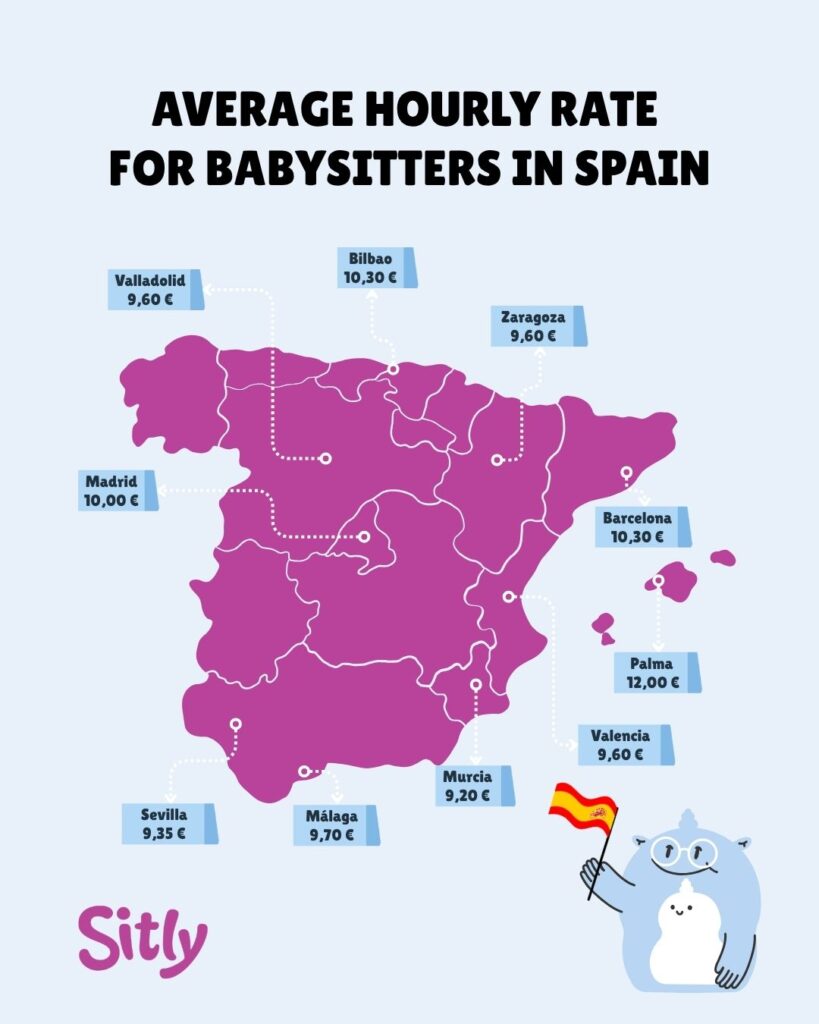
Average hourly rate for babysitters in Spain
| City | Hourly rate |
|---|---|
| Valladolid | €9.60 |
| Bilbao | €10.30 |
| Zaragoza | €9.60 |
| Barcelona | €10.30 |
| Palma | €12.00 |
| Valencia | €9.60 |
| Murcia | €9.20 |
| Málaga | €9.70 |
| Sevilla | €9.35 |
| Madrid | €10.00 |
How to work out what to charge as a babysitter
Beyond the city where you work, there are many other factors that can help you earn more as a babysitter:
- your experience
- your qualifications
- the number of children in your care
- any additional tasks you carry out for the family.
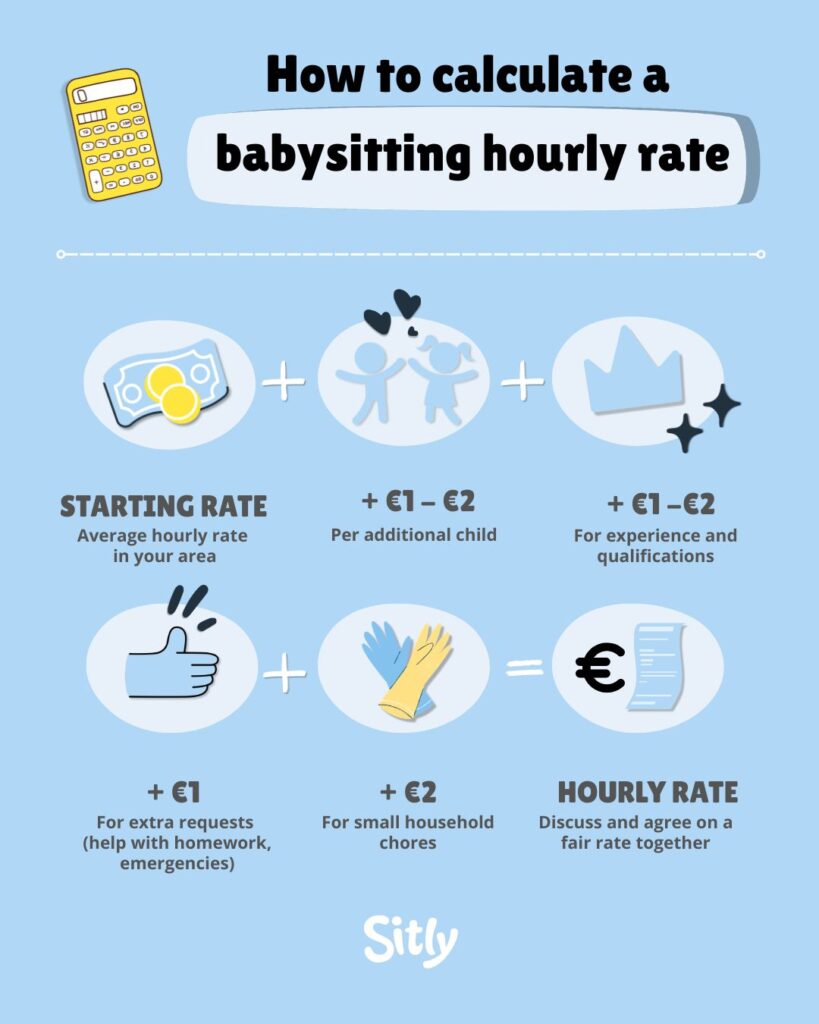
All of these factors directly affect your hourly rate and help you work out what you should realistically charge for your work. The infographic below will help you calculate your hourly rate based on your level of responsibility, experience, and the type of tasks you carry out.
Try the Sitly calculator to instantly see babysitter rates in your area. Enter your city, the tasks involved, and the number of children, and get an average rate straight away.
Infographic: how to calculate a babysitter’s rate
How much to charge for 4 hours of babysitting?
For a 4-hour afternoon, you can charge between €34 and €50, depending on the tasks involved and the number of children. It’s one of the most common shifts: picking the children up from school, having a snack, playing for a while, and preparing dinner before the parents get home.
If you’re looking after one child with no additional tasks, a rate of €8.50–€9.00/hour is reasonable. If there are two children, you’re preparing dinner, or you have experience and qualifications, you can easily reach €10–€12/hour, which works out to between €40 and €48 for the full shift. Always talk to the family before you start to make it clear what’s included in the price.
Example: Lucía, occasional evening babysitter
Lucía is 19 and a university student. She has been working as a babysitter for two years, first for family and then for other families in the neighbourhood. At weekends, she takes on occasional evening jobs.
When she arrives at 7:30pm, the children have already eaten. She just needs to put them to bed at around 8:30pm. She stays until 11:30pm, and at the end of the evening the parents walk her home. The only additional task she’s asked to do is empty the dishwasher; the rest of the time she can relax while the children sleep.
How much should Sara charge?
They agreed on €8.50/hour, a figure that reflects the low level of effort required that evening.
Total for the evening: €8.50 × 4 hours = €34
Lucía is happy with the arrangement: the hours pass quietly and the pay feels fair. So are the parents, knowing they’ve set a clear rate that suits the situation.
How much to charge for 8 hours of babysitting?
For a full 8-hour day, you can charge between €70 and €100, depending on your experience, the number of children, and the tasks involved.
Example: Emma, 20, two children, full day in Barcelona
Emma is 20 and has been working as a babysitter for three years. She is studying Early Childhood Education and holds a paediatric first aid certificate.
On Saturdays she looks after two children aged 4 and 7. She arrives at 9:00am, prepares breakfast, takes them to the park in the morning, and comes back home for lunch. In the afternoon they play, the older one does some reading, and Emma prepares an afternoon snack. The parents return at 5:00pm.
How much should Emma charge?
- €9.26/hour → legal minimum rate (domestic employment, 2026)
- +€2.00/hour → for looking after a second child
- +€1.00/hour → experience and paediatric first aid certificate
- = €12.26/hour
For an 8-hour day: €12.26 × 8 = €98.08
Emma and the family agree to round up to €98 or €100, a clear and fair rate for both sides.
How much does an experienced and qualified babysitter earn?
If you have years of experience working with children or hold a specific qualification (such as an early years educator, nursery assistant, activity leader, or childhood care technician), you can charge more than the minimum. Families value and pay more for babysitters who show professionalism, confidence, and educational skills.
How much does a babysitter charge for two children?
When you look after two or more children, the hourly rate can increase by 10% to 20% above the base rate, depending on the level of responsibility. Looking after two young siblings requires more attention and energy than caring for a single older child. And if the children are very different ages, adapting to both can be even more demanding, something that should also be reflected in your final rate.
Babysitters who also help with light household tasks
Tidying the children’s room, preparing their meals, or washing up the dishes they’ve used are all part of a babysitter’s normal duties. But if the family asks you to do other household tasks, such as dusting, doing the laundry, or hoovering, these should be paid separately, as they fall outside the scope of childcare.
Rate for babysitters who use their own car
Many babysitters drive children to school, dance classes, or the swimming pool. If you use your own car for these journeys, it’s a good idea to agree a fixed weekly or monthly reimbursement with the family to cover fuel costs and vehicle use.
How much does a babysitter earn for night work?
Evening and overnight childcare tends to pay a little more, as it involves less convenient hours and, in many cases, staying late or even sleeping at the family’s home. In general, for night work you can ask for between 10% and 20% more than your daytime rate. For example, if you normally charge €8 per hour, you could ask for €9 or €9.50 for evening shifts, especially if you stay after 10:00pm or sleep over.
That said, it also depends on the type of work:
- If you arrive when the children have already eaten, they go to bed early, and they sleep well, you may be happy to accept a slightly lower rate.
- But if the children are young or wake up several times during the night and you need to stay alert, it’s fair to ask for a higher rate.
Safety tip. Agreeing on how you’ll get home safely is essential. Talk to the parents about how they’ll ensure your safety. Will they walk you home or to your car? Will they cover a taxi? Your safety should always come first, and it’s important to make this clear from the start.
Hourly pay or a fixed monthly rate?
It depends on the type of arrangement you have with each family.
- If you work occasionally or your hours change often, an hourly rate is best, so you’re paid only for the time you actually work.
- If you work regularly with the same family, it may be more convenient to agree a fixed monthly rate.
In that case, make sure you clarify exactly what the monthly payment covers:
- Will you still be paid if they don’t need you on a given day?
- What happens if they ask you to stay two extra hours due to an unexpected situation?
- What if there are more working days than usual that month?
Tip: get all of these points agreed in advance to avoid misunderstandings and keep your working relationship with the family smooth and professional.
Last-minute or emergency babysitting rate
What happens if the family calls you at short notice due to an emergency, for example if a child wakes up with a fever or the parents have an unexpected commitment? In these cases, you can apply a higher rate (an additional 10%–20%) for your immediate availability.
The ideal approach is to agree an “emergency rate” from the start, to apply whenever you’re asked to come at short notice. That way, everything is clear and your flexibility and commitment are fairly rewarded.
How much does a babysitter earn per month in Spain?
A babysitter’s monthly salary can vary quite a bit depending on hours worked, experience, and the type of arrangement with the family. A part-time babysitter working around 20 hours a week typically earns between €700 and €900 per month.
If you work full-time and have experience or qualifications working with babies, young children, or children with special needs, your monthly earnings can exceed €1,200.
Some babysitters with greater responsibilities, or those who live with the family, may earn even more, though in those cases the arrangements tend to be more stable and regulated, with Social Security contributions and recognised employment rights.
How much does a babysitter charge per day?
If you only work a few days a week, for example during school holidays or when parents are away for work, you can agree a daily rate instead of an hourly one.
The calculation is straightforward: multiply your hourly rate by the hours you actually work. A full 8-hour day can be paid at between €70 and €90, though the amount can go up if you’re looking after young children, preparing meals, or staying into the evening.
Tip: always agree with the family in advance what the schedule will be, what tasks you’ll be carrying out during the day, and how any extra hours will be paid if something unexpected comes up.
How to set your rate as a babysitter
When deciding on your hourly rate, take several things into account: your qualifications and experience, the number and ages of the children, the average rate in your area, the time of day you work (daytime or evenings), and any additional responsibilities the family assigns to you.
Once you’ve worked out your ideal rate, the next step is to discuss it openly with the family. It might feel a little awkward at first, but being upfront about pay from the start is the best way to avoid misunderstandings and begin the working relationship on a solid footing. Go into the conversation prepared: look into the usual rates in your area and be ready to explain your rate and the reasons behind it.
You can also ask the family what figure they had in mind, as that can make it easier to reach a fair agreement for both sides.
Also read our tips on how to prepare for your babysitting job interview with the family, and how to start working as a babysitter with no experience.
Table of contents


FAQs

The rate depends on your age, experience, the city, and the tasks involved. In general, babysitters in Spain charge between €8 and €12 per hour for occasional work. In larger cities or if you have more experience, the rate can rise to €12–€15 per hour. For evening work, weekends, or last-minute requests, it’s common to charge a little extra.
To set a fair price, take into account: your experience and qualifications (first aid, childcare courses, years of experience), the number of children and their ages (babies typically command a higher rate), any additional tasks involved (bathing, dinner, homework, school pick-up), and the hours (evening and night shifts tend to pay more).s—many families increase the hourly rate for times that are considered less convenient or higher demand.
Looking after more than one child increases the level of responsibility and attention required, so the rate goes up. In general, an extra €1 to €3 per hour is added for each additional child, depending on their ages and needs.


Flexible babysitting jobs, just around the corner
Love spending time with kids? Become a Sitly Sitter! We connect you with families looking for a reliable sitter. Set your own schedule, choose your rates, and meet families nearby. Get started today!

Related Articles
Calculate Your Babysitter’s Rate with the Sitly Calculator
Find out how much to pay a babysitter in your area. Sitly’s Babysitter Rate Calculator shows average rates across Spain and helps you estimate a fair hourly wage based on your city, number of children, and any extra duties. Get a clear and personalized indication of what families and babysitters usually agree on.

18 Easy Part-Time Jobs as a Student: from Babysitting to Tutoring and Private Lessons
Seeking to earn some extra money as a student or in addition to your current job? Finding the right part-time work can provide you with the flexibility to earn an income while still focusing on school and your personal life. In this guide, we’ve rounded up19 of the best and most flexible side jobs. Many of them can be done from home, like filling out online surveys, babysitting, or tutoring, while others let you get outside, be creative, or meet new people.

How to Become a Great Babysitter
If you want to become a babysitter and find regular work, the key is to build experience, gain parents’ trust, and show that you take the role seriously. Even if you’re young, you can start by helping family members, offering to work as a “mother’s helper,” taking a First Aid and CPR course, and creating a professional babysitter profile on a platform like Sitly. By setting a fair hourly rate based on your age, experience, and responsibilities, and by going the extra mile during each job, you’ll increase your chances of getting more babysitting work and keeping parents happy.