How much does a babysitter cost? In this in-depth guide, you’ll find everything you need to know about babysitting costs in Spain. Average hourly rates, what to pay based on age, experience, and location, and how extra tasks like cooking or caring for multiple children can impact the rate. With real-life calculation examples, a table of minimum wages, and helpful tips to help you decide on a fair rate.
Are you wondering how much a babysitter charges per hour in Spain in 2026? The average rate is €9.46 per hour, though the price can vary quite a bit depending on the city, experience, and number of children. The cost can also change depending on the type of babysitter, the responsibilities involved, and the hours (evenings, weekends, or public holidays).
If you’re thinking about hiring a babysitter, this guide covers updated rates, the cost of a babysitter for two children, the minimums set by the domestic employment agreement, and how to work out the right rate for your situation.
If you’re a babysitter yourself, check out our guide on how much you can earn working as a babysitter in 2026.
Legal minimum rate and applicable regulations in Spain
When deciding on a fair rate for your babysitter, it’s important to consider the minimums set by employment law. In Spain, babysitting falls under the domestic employment sector, regulated by Royal Decree 1620/2011 and updated by more recent legislation.
Spanish law distinguishes mainly between two types of domestic employment:
- External domestic employees (hourly): work a limited number of hours without living in the employer’s home.
- Live-in domestic employees: live in the home and have additional entitlements (rest periods, meals, etc.).
Legal minimum rates for domestic employees
| Type of work | Legal minimum gross pay | Notes |
|---|---|---|
| Full-time 40h, 14 payments | €1,184/month | For 40h per week as standard working hours |
| Full-time 40h, 12 payments | €1,381.33/month | Bonus payments pro-rated |
| Hourly work (non-live-in) | €9.26/hour gross | Includes proportional share of holiday and bonus pay |
| Hourly work (extras not included) | ~€8.63/hour | If bonus payments/holidays are not pro-rated |
On top of the base salary, Social Security contributions must be added, which vary depending on hours worked, as well as the two mandatory annual bonus payments, severance pay, and holiday entitlement.
Hourly babysitter rates in Spain
According to Sitly platform data, the national average rate for a babysitter in Spain is around €8.50–€9.50 per hour. However, the price varies quite a bit depending on the city and the babysitter’s experience.
- In Madrid or Barcelona, it’s common to pay over €10/hour.
- In mid-sized cities such as Murcia, Seville, or Valladolid, the average is around €9.30/hour.
- In smaller towns or some rural areas, rates tend to be lower, at around €8/hour.
That said, hiring a qualified babysitter in Seville doesn’t always cost less than in Barcelona: a babysitter with specific experience — for example in newborn care or with paediatric first aid certification — may charge above the average even in lower-cost cities.
In short, averages give you a rough idea, but the real cost of a babysitter always depends on the combination of factors that actually matter: skills, availability, tasks included, and the city where you live.
Hourly babysitter rates in Spain’s main cities
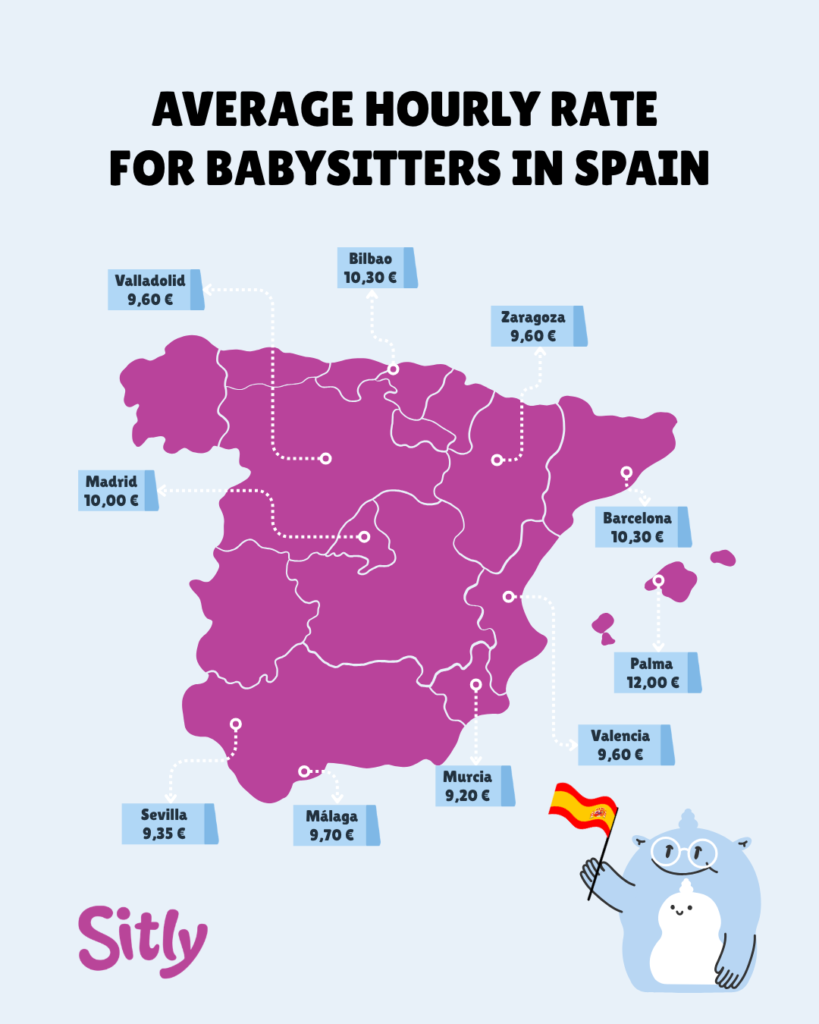
Rates requested by babysitters registered on Sitly. Database of 364,000 babysitters.
| City | Hourly rate |
|---|---|
| Valladolid | €9.60 |
| Bilbao | €10.30 |
| Zaragoza | €9.60 |
| Barcelona | €10.30 |
| Palma | €12.00 |
| Valencia | €9.60 |
| Murcia | €9.20 |
| Málaga | €9.70 |
| Sevilla | €9.35 |
| Madrid | €10.00 |
Hourly pay or a fixed rate? How to choose
The most common way to pay a babysitter in Spain is by the hour. It’s straightforward, transparent, and above all fair: you pay exactly for the time she spends with your children. This works very well when you need help occasionally, at variable hours, or even at short notice.
However, there are situations where a fixed rate (weekly or monthly) may be more convenient, both for you and for the babysitter. For example, if she comes every morning to take the children to school, or stays with them every Friday evening. In these cases, agreeing on a stable rate makes things easier to organise and helps you plan your family budget.
How to choose between an hourly or fixed rate
When agreeing on a salary with your babysitter, the first decision is whether to pay by the hour or set a fixed rate. The answer depends mainly on how regular and predictable your needs are.
- Hourly pay is the most recommended option if you want flexibility. For example, if you don’t always get home from work at the same time, you often need extra help, or you sometimes ask the babysitter to do additional tasks. With an hourly rate you pay exactly for the time worked, and she’ll be more motivated to adapt when something unexpected comes up.
- Fixed rate (weekly or monthly) is more practical when hours are regular and predictable (for example, every Saturday evening or every morning before school). It’s easier for you to plan your budget, and the babysitter can count on a stable income each week or month.
Things to bear in mind if you pay your babysitter a fixed rate
- Clarify what’s included: number of children, whether light household tasks are expected, transport compensation if she takes the children to activities.
- Allow for an extra or bonus in case of unexpected situations, such as staying longer than agreed or lending an extra hand.
- Honour the agreed payment: even if one week you decide not to go out and don’t need the babysitter, the agreed fixed rate should still be paid, as it forms part of the stability and commitment of the arrangement.
How much does a babysitter charge per hour: experience and qualifications
A babysitter’s skills and experience have a significant impact on what she charges and what she expects to receive. It’s not just about age:
- A 24-year-old student with a qualification in early childhood education or a paediatric first aid certificate will naturally ask for a higher rate.
- A 19-year-old who already has considerable experience caring for children of different ages can also ask for more than the minimum.
In general, the more experienced or qualified the babysitter, the more reasonable it is for her hourly rate to be above average. Many babysitters today have additional training: paediatric first aid, Montessori methodology, or studies in psychology and education. All of this justifies a higher rate.
As a parent, the decision is personal: you can choose to hire someone with less experience and pay a lower rate, or be willing to pay more for a babysitter with training and credentials who gives you greater peace of mind. There’s no right or wrong answer — what matters is that the arrangement is fair for both sides and that you have confidence the babysitter can look after your children well and ensure their wellbeing.
Try the Sitly calculator to instantly see babysitter rates in your area. Enter your city, the tasks involved, and the number of children, and get an average rate straight away.
What tasks does your babysitter carry out?
A babysitter’s hourly rate doesn’t just depend on her age or experience — it also depends on the responsibilities she takes on. If you ask her to handle more tasks than usual, it’s natural for the price to go up. Some practical examples:
- Looking after several children: caring for two or three at once requires far more energy and attention than looking after just one. In this case, it’s fair to recognise this with higher pay.
- Children with special needs: if your children require specific routines, constant care, or additional support, the rate should reflect that level of responsibility.
How much does a babysitter charge for 4 hours?
A babysitter charges between €36 and €50 for 4 hours in Spain, depending on experience, the city, and the number of children. The following example helps you work it out.
Example: Lucía, babysitter for 4 hours, 3 children in Madrid
Lucía is 19, has plenty of prior experience, and has just started a degree in Early Childhood Education. She also holds a paediatric first aid certificate.
Once a week she works for a family with three children aged 8, 5, and 3. She arrives at 4:00pm, picks up the youngest from nursery and then the two older ones from school. At home they have a snack and play; if the weather is nice, they go to the park. She then prepares dinner and makes sure the children have eaten before the parents arrive home at around 8:00pm.
How much should Lucía charge?
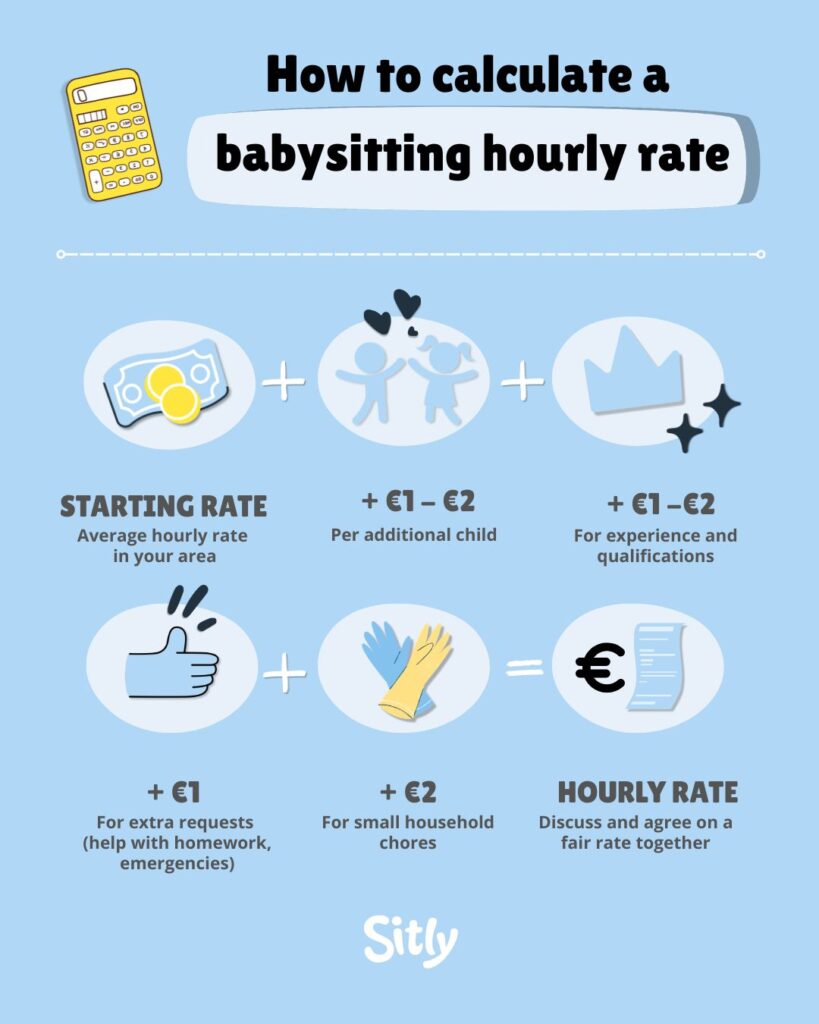
- €8.45/hour = national minimum wage (SMI 2025, pro-rated for domestic employees on hourly pay)
- +€2.00/hour = supplement for caring for three children instead of one
- +€1.00/hour = recognition for experience and paediatric first aid certification
- = €11.45/hour
For 4 hours, the total cost would be approximately €45.80 for the afternoon. In practice, this figure is usually rounded to make payment easier: for example to €46, €45, or even €50, depending on the agreement between the family and the babysitter.
How much does a babysitter charge for 8 hours in Spain?
A babysitter charges between €70 and €95 for 8 hours in Spain, depending on experience, the city, and the number of children. The following example helps you work it out.
Example: Sara, babysitter for 8 hours, 1 child
Sara is 22 and is studying Early Childhood Education. She has been working as a babysitter for three years and holds a paediatric first aid certificate.
On Saturdays she looks after a 4-year-old child in Barcelona. She arrives at 9:00am, prepares breakfast, takes him to the park in the morning, gives him lunch, and stays with him during his nap. In the afternoon they play at home until the parents return at 5:00pm.
How much should Sara charge?
- €9.26/hour = legal minimum hourly rate (domestic employees, 2026)
- +€1.00/hour = recognition for experience and first aid certification
- +€0.50/hour = supplement for meal preparation
- = €10.76/hour
Sara works 8 hours, so the total cost would be approximately €86. In practice, many families round this to €85 or €90, depending on the agreement with the babysitter.
Babysitter hourly rate: the age of the children
Your children’s age is a key factor when setting a fair rate.
- Babies and young children require constant, uninterrupted attention. The babysitter must always be alert, engaged, and ready to step in. For this reason, caring for babies in the Spanish market is generally paid at a higher rate than caring for older children.
- Children aged 6 and over tend to be more independent: they eat on their own, use the bathroom without help, and can entertain themselves. This reduces the babysitter’s workload and, as a result, the hourly rate can be lower.
In short: the younger and more dependent the children, the more energy and responsibility their care requires — and it’s fair for the rate to be higher accordingly.
Compensation for light household tasks
Some basic tasks are part of a babysitter’s normal duties: tidying up the room after play, preparing the children’s dinner, or washing the dishes they’ve used. But if you want her to help with light household tasks that go beyond childcare, you should pay extra.
Examples of tasks that justify a supplement:
- loading or unloading the dishwasher
- hanging out and bringing in the laundry
- washing up
- preparing dinner for the whole family
- hoovering
- dusting
Bear in mind that in these cases you’re asking her to do something beyond looking after the children. As a reference, a domestic employee in Spain earns around €8.45/hour, though in many cities the real rate is closer to €9–€10/hour. If your babysitter also helps with household tasks, it’s right to recognise this with a supplement on top of the base childcare rate.
How much does a babysitter charge at night?
At night, a babysitter typically charges between €9.50 and €12/hour. Evening babysitting tends to pay a little more, as it involves staying late and adapting to less convenient hours. Although during the day a babysitter usually has more tasks — such as collecting the children from school, taking them to after-school activities, preparing snacks or dinner, supervising play, or managing bath time and bedtime routines — at night the responsibility can be greater.
During evening babysitting, children may wake up or need attention at a sensitive time of day, and it can sometimes be harder to settle them or get them back to sleep. For this reason, night work is generally paid around 20% more than the standard rate.
However, if the children are calm and go to sleep shortly after the babysitter arrives, some families and babysitters may agree on a slightly lower rate for those hours.
Example: Lucía, evening babysitter
Lucía is 19 and a university student. She has been working as a babysitter for two years, first for family and then for other families in the neighbourhood. At weekends she takes on occasional evening jobs.
When she arrives at 7:30pm, the children have already eaten. She just needs to put them to bed at around 8:30pm. She stays until 11:30pm, and at the end of the evening the parents walk her home. The only additional task she’s asked to do is empty the dishwasher; the rest of the time she can relax while the children sleep.
How much does Lucía charge?
They agreed on €8.50/hour, a figure that reflects the low level of effort required that evening.
Total for the evening: €8.50 × 4 hours = €34
Lucía is happy with the arrangement: the hours pass quietly and the pay feels fair. So are the parents, knowing they’ve set a clear rate that suits the situation.
Last-minute or emergency babysitter rate
Do you need a babysitter at short notice? That flexibility comes at a price. Emergency call-outs often mean the babysitter has to cancel personal plans or reorganise her entire day, especially if she’s studying or has another job. In these cases it’s fair to offer a supplement: immediate availability is a convenience for you, but her effort should be rewarded.
Example: Marta, on-call emergency babysitter
Marta has an arrangement with a family to act as a back-up babysitter in emergency situations. One morning, Sergio’s mother calls her at 7:00am because the child has a fever and can’t go to nursery, but she has an important meeting to attend. Marta arrives at 8:00am and stays until 1:00pm, when the grandmother arrives.
How much does Marta charge?
- €8.45/hour = national minimum wage reference for hourly domestic employees (2025)
- +20% emergency supplement ≈ +€1.70/hour
- = €10.15/hour
For a 5-hour shift: €10.15 × 5 = €50.75
Many families would round this up to €51 or €52 to show they value her immediate availability. That way Marta feels appreciated, and the parents have the reassurance of knowing they can count on her in emergencies.
The difference between a canguro and a niñera
Although many people use the terms canguro and niñera interchangeably in everyday speech, they don’t actually mean the same thing.
A canguro (casual babysitter) typically offers a more occasional service, for those times when parents need an extra pair of hands: a dinner out, a work meeting, or simply a night off. They’re often young women or students who combine their studies with childcare to earn some extra money.
A niñera (nanny), on the other hand, has a more stable and professional role within the family. She usually works regular hours, sometimes under a monthly contract, and her duties go well beyond basic childcare. Many nannies have qualifications in early childhood education or first aid and solid experience caring for children of different ages. As a result, their salary tends to be higher: between €10 and €15 per hour, or between €1,200 and €1,500 per month for full-time work.
How much does a live-in nanny earn in Spain?
Within the world of nannies, there are two very common types: live-in and live-out. The main difference lies in where they live and their availability.
A live-in nanny becomes almost part of the family. She lives in the home and takes care of the children throughout the day, sometimes at weekends too. In addition to her salary, she receives accommodation and meals, which makes the arrangement more convenient for both sides. In 2026, the salary of a live-in nanny in Spain is typically between €1,200 and €1,800 per month, depending on her experience, working hours, and the tasks involved.
A live-out nanny, on the other hand, works fixed hours, like any other job. She usually starts early and finishes in the afternoon when the parents get home. At the end of the day, she returns to her own home. Her salary is typically between €1,000 and €1,400 per month, though many families opt to pay by the hour if the work is part-time.
So, how much should you pay your babysitter?
There’s no single answer to the question of how much a babysitter charges. The fair rate depends on several factors, including:
- the babysitter’s age, experience, and qualifications
- the number and ages of your children
- any additional tasks included
- whether you need help during the day, in the evening, or at night
- the city where you live
- and, of course, your family budget
Ultimately, it’s about finding the right balance between the babysitter’s expectation of fair pay and your family’s needs and means.
The most important thing is communication: talk openly with the babysitter about your expectations, the tasks involved, and the rate. Only then can you reach an agreement that feels fair for both sides.
Table of contents


FAQS

A live-in nanny earns between €1,200 and €1,500 per month, including room and board. If they work with babies or large families, the pay can rise to €1,700, depending on the hours and responsibilities of the position.
A babysitter charges between 8 and 12 euros per hour, depending on experience, the city, and the tasks included. In Madrid and Barcelona, rates are usually between 10 and 12 euros per hour, while in smaller cities they range from 8 to 10 euros per hour.


Trusted sitters, right around the corner
Need a little help? Sitly connects you with experienced babysitters in your area. Whether you need occasional or regular care, finding the right babysitter is super easy. Browse profiles, read reviews, and reach out to your favorites right away.
Related Articles
When is a baby old enough for a babysitter?
Wondering when your baby is old enough for a babysitter? While there’s no single “right” age, short and gradual separations are possible even in the early months when the babysitter is experienced and routines are respected.
Calculate Your Babysitter’s Rate with the Sitly Calculator
Find out how much to pay a babysitter in your area. Sitly’s Babysitter Rate Calculator shows average rates across Spain and helps you estimate a fair hourly wage based on your city, number of children, and any extra duties. Get a clear and personalized indication of what families and babysitters usually agree on.

10 Ways to Help Your Child Overcome Fear of Monsters at Bedtime
If your child is afraid of monsters at bedtime, you’re not alone. Many kids aged 3 to 6 struggle with nighttime fears fueled by imagination and change. In this article, you’ll learn why these fears happen, how to validate them, and 10 simple, creative ways to help your child feel safe and sleep peacefully. From using nightlights and comforting routines to anti-monster sprays, magic spells, and stuffed animal bodyguards—each idea is designed to reduce anxiety and empower your child at night.